What Is Performance Marketing? Ultimate Guide 2025
September 24, 2025Digital Marketing
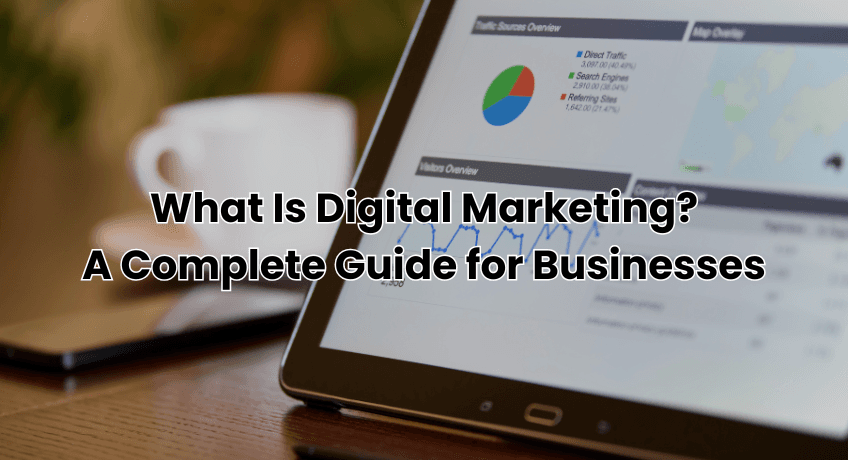
Digital marketing is the use of digital technologies to market products or services, primarily on the Internet, but also including mobile phones, display advertising, and any other digital medium.
It includes a wide range of tactics, including search engine optimization (SEO), pay-per-click advertising, email marketing efforts, and content marketing that allow us to reach customers in the digital spaces that they’re in.
And let's be honest, almost half of the world is already online.
According to eMarketer’s latest estimates, in 2017, about 47 percent of the world’s population were using the internet, and of those, more than 2.7 billion people were using it on their mobile devices only.
For business owners, this is not a fad, it’s a clear indication that the market is moving online.
This manual will assist you to get to grips with what digital marketing actually is, the different channels involved and how to work out where it’s best to start for your business.
Digital marketing is any marketing that uses an internet-connected device or media to reach a target audience.
It's a broad definition for a reason – it covers everything from an ad in a Google search, to a post on Facebook, to a marketing email, to a blog post that makes it to the first page, to a banner ad on a news site.
The common denominator of all these methods is that they are measurable.
Unlike a traditional newspaper ad or billboard, just about any digital channel can give you precise data on how many people viewed it, clicked on it, and, if all is right with the world, made a purchase because of it.
It’s this crucial difference that has seen marketing budgets shift online over the years, and there’s no sign of this trend changing anytime soon.
Here are some related terms that might be useful:
As small and mid-sized businesses start venturing into the world of digital marketing, they will often come across industry tools like Google AdWords, Google Analytics, MailChimp, and Hootsuite.
Most digital marketing activity falls into a handful of channels.
Understanding what each one does — and doesn't do — is the first step before spending a single rupee on any of them.
Ninety-three percent of online experiences start with a search engine, according to data cited by Vimeo, which is the single biggest reason SEO and SEM tend to sit at the centre of most digital strategies rather than at the edges.
The shift toward digital isn't a prediction anymore — it's already happened in most categories.
Social media alone had roughly 2.3 billion active users by early 2017, and 91 percent of retail brands were already active on two or more social channels, according to Brandwatch.
B2B marketers were putting an average of 28 percent of their total marketing budget into content marketing alone, per the Content Marketing Institute — a category that barely existed as a line item a decade earlier.
Local businesses have an even stronger case.
WordStream data shows 72 percent of consumers who did a local search ended up visiting a store within five miles, which means a business without a properly optimised Google listing and local SEO presence is quietly losing walk-in customers to a competitor who shows up first.
These two get confused constantly, so it's worth separating them clearly.
SEO is the unpaid, organic listing — the result you earn through relevant content, a technically sound website, and other sites linking back to you.
It typically takes several months to show real movement, but the traffic keeps coming without a per-click cost once it ranks.
PPC, run mainly through Google AdWords, is the paid listing — you bid on keywords, pay every time someone clicks, and the traffic stops the moment the budget runs out.
Neither replaces the other.
A new website with zero search history usually needs PPC to generate leads in the short term, while SEO gets built in the background to reduce that dependence on paid clicks over the following six to twelve months.
Content marketing — blog posts, guides, videos, infographics — earns attention instead of buying it outright.
WordPress users alone publish around 76 million new posts and attract more than 409 million people viewing over 22 billion pages every month, which gives some sense of just how much content is already competing for the same audience's attention.
The businesses that do this well treat content as an asset, not a one-off task.
A well-written guide published this year can still be bringing in search traffic two or three years down the line.
If SEO and PPC bring people in, email and social media are what keep them coming back.
Email remains one of the most cost-efficient channels available, since the list is owned outright rather than rented from a platform's algorithm.
Social media, meanwhile, plays more of an awareness and engagement role.
Internet users now maintain an average of 5.54 social media accounts, according to Brandwatch, spreading attention across more platforms than ever.
Start with one clear, measurable goal — more phone enquiries, more online orders, or more footfall — rather than trying to run every channel at once.
Set up Google Analytics and a Google AdWords account before spending on anything else, since without tracking in place there's no way to know which channel is actually working.
Running SEO, AdWords, content, and social media properly takes more hours than most business owners have spare in a week.
This is where a digital marketing agency in Chennai typically comes in — bringing existing tools, tested processes, and a team that isn't learning each channel from scratch on your budget.
Businesses across Chennai's travel, real estate, education, and hospitality sectors are increasingly turning to a digital marketing company in Chennai instead of hiring and training an entire in-house team.
A capable digital marketing agency in Chennai — firms such as Weboin Technologies among them — usually brings SEO, AdWords management, content, and reporting together under one team rather than juggling separate freelancers for each piece.
For a business trying to get results without spending a year learning digital marketing by trial and error, working with an established digital marketing company in Chennai is often the more practical starting point.
Digital marketing isn't one tactic — it's the umbrella covering all of these channels, tied together by the fact that almost everything can be measured.
Start with one goal, one or two channels done properly, and expand from there once the numbers back it up.
Whether that's handled in-house or through a digital marketing agency in Chennai, the businesses that treat it as a system rather than a one-off campaign are the ones still seeing results a year later.
Expert digital marketer, copywriter, and developer creating cutting-edge digital growth strategies.
No comment yet, add your voice below!
Your email address will not be published. Required fields are marked *
Get a free, comprehensive SEO audit of your website and discover untapped growth opportunities.
Explore more insights related to this topic